

Funding guide
This guide is designed to help your community group or not-for-profit organisation apply for funding.

This guide is designed to help your community group or not-for-profit organisation apply for funding.
There are lots of different funding organisations that provide grants to community and not-for-profit organisations. It can be challenging to find the funder or funders who are most likely to be interested in supporting your work.
This resource will provide you with information on funders, what they are looking for, the types of funding available and how to identify which funders are most likely to support your type of organisation or project.
It provides an overview of the information you will need for an application. The guide will help you build up a collection of the key documents most funders will want to see. This will save you time when you are applying to more than one funder.
Finally, we have provided some helpful tips from other organisations about applying for funding, as well as some tips from funders.
The mahi of making a difference for our communities is important, and applying for funding can be challenging and time consuming. We hope this resource makes that task a little easier.

You are ready for funding
And you want to find the funder that is right for you. That means identifying the funder or funders that are most likely to support your work.
Use the list of funders below as your starting point. Which funders look as though they might support your organisation or project? Check out their websites and their strategies. What are their goals? What sorts of grants do they make? What are they most interested in supporting? Most funders have strategies that include information on the sorts of work and organisations they want to fund. They may want to fund work on sustainable housing, for example, or rangatahi health. Find the funders that are interested in the sorts of issues your organisation is involved in.
You then want to understand whether a funder can offer the type of funding you need. Funders will also have different approaches to funding. Some will provide short-term grants for a one-off activity. Others will want to fund projects and organisations where they can see the potential of bringing longer-term positive change in communities.
This basic research can save you time and energy in the long run by making sure your application goes to funders who are passionate about the same things you are, and who can provide the short or long-term funding options that will work for your organisation.
You then want to know about the application process. Some funders will be open to applications at various times during the year. You want to know what date you need to submit your application, what information and supporting documents you need to provide. Once you know what the funder is looking for, you can start the application. If you get lost or need support, most funders will be happy for you to email them or call them for support.
Some funders now have a relationship-based funding process. A funder interested in restoring natural environments, for example, will look to fund organisations that are doing work on this issue. They will look to build relationships with these organisations that may result in long-term funding partnerships.
Video: Josh Martin, Engagement Advisor at Foundation North, gives an overview of the Foundation’s approach to funding - including what organisations and initiatives are eligible, focus areas and communities, and funding pathways
Types of funders in Aotearoa
Funding available to community organisations in Aotearoa New Zealand generally comes from eight main types of sources.
These are community trusts, energy trusts, government and council funds, community foundations, gaming trusts, family and individual trusts and foundations, licensing trusts, and corporate foundations. Each of these sources and the individual funds within them has its own criteria, priorities, and processes for giving grants, reflecting the diverse needs and goals they support.
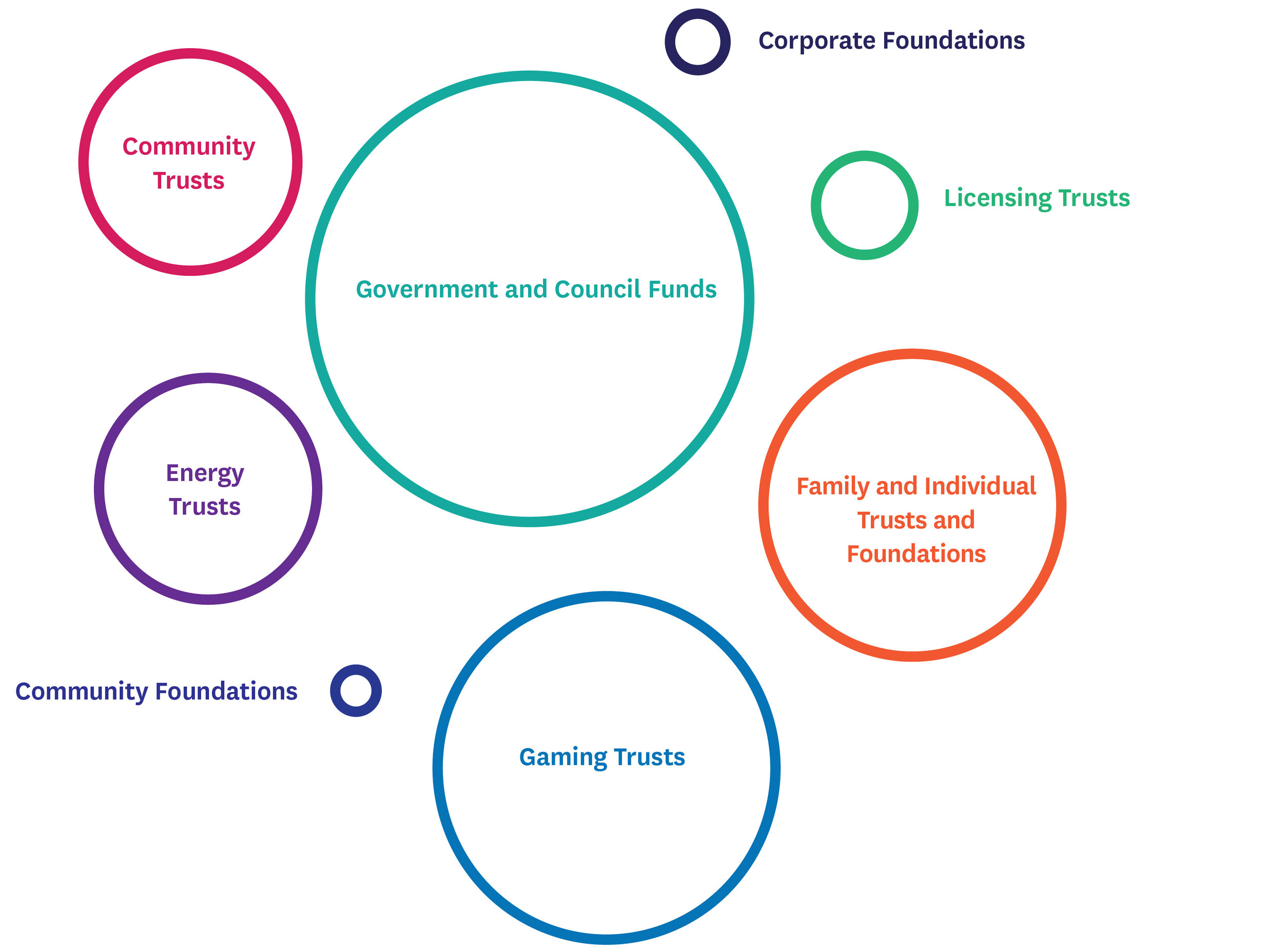
The image above represents these eight key sources of funding and their approximate relative size in terms of grant money distributed annually. This ranges from nearly $400 million each year across all government and council funds to about $4 million across 17 community foundations.
Descriptions of these eight funding sources and a sample of entities within that group, including how and what they fund, are detailed in the following section. This information provides a broad overview and sample of funds, not a complete list.
Look for other options in the Helpful Tips section of this guide.
Image caption: This graphic was developed using analysis from the following sources:
- JB Were. The New Zealand Support Report: The current state and significance of giving in New Zealand and the outlook for recipients. 2020. Available here.
- BERL (Business and Economic Research Limited). Giving New Zealand: Philanthropic Funding 2014. Prepared for Philanthropy New Zealand. Available here.
A sample of community foundations
| Name | How they fund | What they don't fund |
| Nikau Foundation nikaufoundation.n | Applications for wider Wellington region open Feb/Mar. Funding salaries, capital expenditure, operating costs and more. | Unable to support divisive religious activities, individuals, political parties and activity outside of greater Wellington region. |
| Northland Community Foundation | The Northland Grassroots Fund opens April/May and provides grants up to $15,000. Projects must support children, young people and their whānau/families. More information. | Excluding core health and disability services, education, sports, leisure and recreation, arts, plus more. |
| Top of the South Community Foundation | Annual grant period 1 - 30 June. Funding level of $2,000-$8,000 in Nelson and Tasman and $1,000-$3,000 in Marlborough. | Not listed, however applications will need to benefit people in this geographic region. |
Community foundations of Aotearoa New Zealand have more information about the foundations around the country, here.
A sample of community trusts
| Name | How they fund | What they don't fund |
| Community Trust South communitytrustsouth.nz | Funding people and ideas that benefit our community. General grants up to $75,000 and major grants over $75,000. As well as specialist funds for sports, kapa haka, school and early childhood education. More information here. | Excluding projects outside the geographic region, repeat requests for the same project, completed projects, more than one approved request within a 12 month period. Including others. |
| Foundation North foundationnorth.org.nz | Four funding focus areas: hāpai te ōritetanga - increased equity, whakauru mai - social inclusion whakahou taiao - regenerative environment and hāpori awhina - community Support and a particular interest in activities that have regard to Te Tiriti o Waitangi and Climate Action Offer quick response grants up to $25,000, community grants over $25,000, impact grants by invitation. | Excluding some education initiatives, core health services, individuals, international costs, conferences and others. |
| Toi Foundation toifoundation.org.nz | Committed to supporting our communities to build a thriving, inclusive and equitable Taranaki. Four key funds with specific criteria - Strengthening Communities Fund, Strategic Fund, Innovation Fund and Investing for Impact fund. Read the comprehensive information here. | Exclusions are covered with the information provided about each type of fund. |
Further information about community trusts and how they came about, here.
Find the community trust for your local area below:
- Auckland and Northland - Foundation North
- Waikato - Trust Waikato
- Taranaki - Toi Foundation
- Bay of Plenty - Bay Trust
- Tairāwhiti, Hawke’s Bay, Manawatū, Horowhenua, Tararua, and the Wairarapa Eastern and Central Community Trust
- Whanganui - Whanganui Community Foundation
- Wellington - Wellington Community Fund
- Nelson, Marlborough, Canterbury and Chatham Islands - Rātā Foundation
- Buller, Grey, and Westland - West Coast Community Trust
- Mid & South Canterbury - Community Trust Mid & South Canterbury
- Otago - Otago Community Trust
- Southland - Community Trust South
A sample of corporate foundations
| Name | How they fund | What they don't fund |
| ANZ Staff Foundation anz.co.nz | Providing grants to community organisations for projects which benefit as many people as possible. | Do not support - salaries, wages, operational cost, travel, religious, political or hobby causes. |
Harcourts Foundation harcourtsfoundation.org | Support to NZ registered charities. Funding of up to $25,000. | Don't fund - schools, sports clubs, operating costs, fundraising events, equipment purchases. |
| Simplicity Foundation simplicity.kiwi | Provides charitable funding to three core priority areas - the environment, youth development, and homelessness and hunger.
The majority of its giving is directed through medium and long-term charity partners, with the rest allocated to smaller, one-off grants. | Don't fund |
| Spark Foundation spark.co.nz | Their mission is to accelerate towards digital equity. Granting - 75% of funding is multi-year partnerships - 25% for annual grants between $500 - $20,000. Get in touch to discuss funding sparkfoundation@spark.co.nz. | Not specified. |
| Te Rourou One Aotearoa Foundation terourou.one.nz | Te Rourou is committed to creating an equitable Aotearoa for our rangatahi.
Currently no contestable funding rounds available. Some specific funding rounds open occasionally listed under 'current mahi' on their website. | Details provided when a funding round is open. |

A sample of energy trusts
| Name | How they fund | What they don't fund |
| Central Lakes Trust | Provides funding to charitable causes within the Central Lakes region. Funding - project, programme and operational grants. And specific individual tertiary scholarships and art support of up to $2,500. | Unable to support individuals, advocacy, maintenance of facilities and equipment.
More information here. |
| Tauranga Energy Consumer Trust tect.org.nz | Support for local initiatives, facilities and events - Tauranga and Western Bay of Plenty regions.
Funding application details here. | Do not fund uniforms, repairs/maintenance, individuals or informal groups and overseas aid. |
| WEL Energy Trust welenergytrust.co.nz | Funding for Hamilton, Raglan, Huntly, Ngāruawāhia. - Quick response grants up to $20,000 - Community support above $20,000 And support beyond grantmaking. Further information, here. | Do not fund projects outside their locational region. No travel, debit payments, individuals or commercial organisations. |
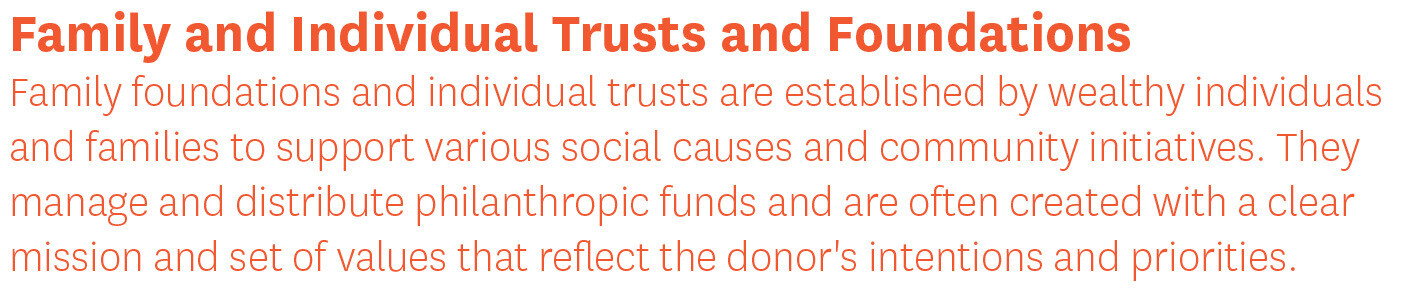
A sample of family and individual trusts and foundations
Name | How they fund | What they don't fund |
Jenkins Foundation jenkinsfoundation.org.nz | Focus areas are global warming, conservation, education, the arts, society and public amenities. Open applications approach based on making contact, then having a follow up and then preparing an application. More information here. | Unable to support - general running costs, wages, salaries. Projects that are not community-led and controlled. Initiatives that are not economically and environmentally sustainable. Individuals, sports, or any closed groups. |
| J R McKenzie Trust | Prioritising children/young people/whānau, Māori, Pacific peoples and communities that experience exclusion. - Innovation fund grants up to $30,000 - impact grants over $30,000 More information here. | Areas which don't align with their strategy eg: travel, buildings, land purchase. Read the full list here. |
| The Tindall Foundation tindall.org.nz | Prioritising family/whānau, community and the environment. - 1/3 funding accepting applications $500-$15,000. - 2/3 funding for impact where Tindall seek out initiatives to work with. More information here. | Information about what is not funded, here. For example arts, sports, health services, animal charities. |
| Todd Foundation | Their funding approach is based on proactively seeking out communities, groups, and collectives to partner with. | One-off projects or service delivery without a systemic change focus. More information here. |
| Wright Family Foundation wrightfamilyfoundation.org.nz | Funding focus on education, music/arts and community.
They accept applications, which are reviewed monthly. | Not noted on their website. |

A sample of gaming trusts
| Name | How they fund | What they don't fund |
| Aotearoa Gaming Trust agt.nz | Fund a wide range of community groups and charitable causes within New Zealand. | Not specified. |
| One Foundation onefoundation.nz | Funding arts, community, culture, education, health and welfare and sports. More information here. | Excluding horse and greyhound racing and breeding, sports players competing professionally. Plus more. |
| The Lion Foundation lionfoundation.nz | Funding arts and culture (30%), health (15%), sport (40%) and education (15%). | Exclusions - retrospective grants, international travel, certain sporting expenses. |
A full list of the gaming trusts here.
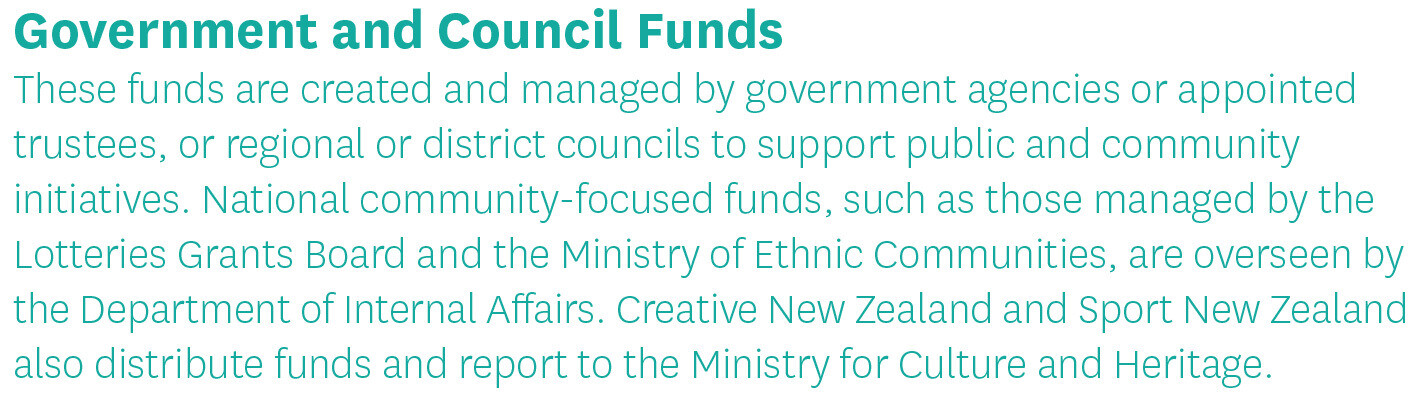
A sample of government and council funds
| Name | How they fund | What they don't fund |
| Auckland Council | Community grants for projects and services that benefit Aucklanders. Including arts, events, community, sports and recreation, environment and heritage. More information and FAQ's here. | Not able to fund legal or medical expenses, central govt services eg: core education, building works. More information here. |
| Christchurch City Council | Assistance for community groups, sports teams, running events, those in financial distress within the Christchurch region. Most of the funds open once per year for applications. | Exclusions include medical costs, debit payments, retrospective events and more. |
| Creative NZ creativenz.govt.nz | Funding for artists and arts organisations. Applicants can speak to an advisor. | Applicants who have received funding for the same project from other sources, including other government agencies, may not be eligible for additional funding from CNZ. Plus additional exclusions mentioned with each fund. |
| Lottery Communities Funding communitymatters.govt.nz | Various funds for different community need and priorities. All funding is contestable and application dates on their website. DIA advisors can provide information and advice. Contact. | Excludes - commercial, political and/or religious objectives, overseas aid, medical expenses or treatment, repaying debits or projects which have been completed. |
| Sport New Zealand sportnz.org.nz
| Sport NZ partners with the country’s network of 14 Regional Sports Trusts to manage and distribute the fund. Grants sizes, criteria and processes vary across regions. | Exclusions include - funding for commercial, political, or religious activities, debt repayment and activities that have already taken place. |
Local Government NZ - Regional Councils List: LGNZ provides a handy list of links to regional councils, each of which usually provide a number of grant options for organisations based in their region. Visit your regional council’s website and type “community grants” into the search box.
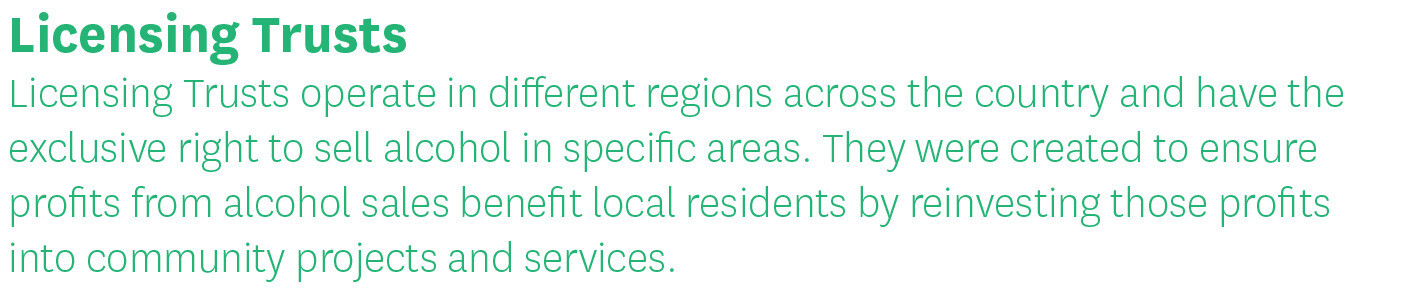
A sample of licensing trusts
| Name | How they fund | What they don't fund |
| Invercargill Licensing Trust ilt.co.nz | Contributing to a vibrant Invercargill.
Funding facilities, arts, education and youth, clubs and associations, health and wellbeing and active recreation. Application and contact details here. | Must benefit the regional location. No other exclusions mentioned. |
| The Trusts (Portage and Waitakere Licensing Trust) thetrusts.co.nz | Surplus profits support local community groups.
There are four avenues for funding: Your West Support Fund; Your West Innovation Fund; Sponsorships and Donations (up to $500); and Supporters Club. Information on how to apply here. | Excluding travel and accommodation costs. Funding must support those within the geographic area of West Auckland. |

Applying for funding – what's needed
Most funders will want similar basic information about your organisation and your project.
Here are some suggestions of the documents and information you want to have ready for your applications.
Description of your organisation
This will include an overview of what you do, who you do it for, and the benefits for your community. Here is a helpful resource from HuiE! for putting together your organisation's description - creating a powerful one-sentence statement for what you do.
Project plan
A project plan provides information about your project or programme for which you are applying for funding. It helps you think through and manage the delivery of a specific piece of work - whether that's running an event, delivering a programme, or completing a funded project.
A good project plan helps you stay organised, use your resources wisely, and demonstrate to funders that you have a clear and realistic approach to your work.
A project plan typically covers:
- Objectives: what you are trying to achieve and how you will know you have succeeded.
- Tasks and activities: the specific steps needed to deliver the project, broken into manageable chunks.
- Timeline: when each task will happen, including key milestones and deadlines.
- Roles and responsibilities: who is responsible for each part of the work.
- Resources: what budget, people, equipment, or other resources are needed.
- Risks: what could go wrong and how you will manage it.
It may also include: an evaluation of how you will track progress and measure the outcomes of your work.
Why it matters for funders
Many funders will ask you to outline your project plan as part of an application, or to report against it during and after the project. A clear plan signals that your organisation has thought carefully about delivery and is a trustworthy steward of funding. It also gives you something to refer back to as the project progresses, helping you identify early if things are getting off track.
Keep it proportionate
A project plan doesn't need to be elaborate. For a small project, a simple one-page table or spreadsheet may be all you need. The level of detail should match the scale and complexity of the work.
Useful resources
- Te Pou Project Management Plan template is an excellent starting point, covering the key areas noted above.
- This 10-minute recorded webinar from Community Think starts with pre-project planning and provides solid, basic guidance on creating the key elements of a project plan.
- Communitynet Aotearoa – guidance on project management/planning.
Budget
Being transparent with your budget builds credibility and potentially makes it easier for funders to trust and approve. Here are some of the things that funders might look for when reviewing a budget.
- Alignment of the budget with the project plan in your application: The budget must closely match the project objectives, activities, outcomes, and timeline described in your application. Every cost (line-item) should directly tie to what you've promised. For example, if you’re running workshops, the budget should include costs such as facilitation, venue hire, kai, or koha.
- Realistic and accurate costings: Provide current estimates for each expense, such as quotes for hire, equipment, or rates for suppliers. Back up any costings with notes or sources to show you've done your homework and aren't over- or under-estimating.
- Avoid under-budgeting: Don't reduce costs to appear efficient or to fit a perceived grant size. This puts the project at risk of failure, incomplete delivery, or the need to seek additional funds later. Budgets need to reflect actual needs, even if it means requesting a higher amount.
- Transparent assumptions and notes: Clearly explain the key assumptions behind your figures so funders can quickly see your thinking is solid and realistic. For example, you could note things like:
- “Venue hire based on current quotes from two local community centres at $220 per day”
- “Travel costs calculated using the IRD-approved mileage rate of $1.17 cents per kilometre”
- “Catering estimated at $18 per person based on quotes for 50 participants”.
- “7% contingency included to cover possible price rises or minor weather-related changes in outdoor activities”.
Also include clear breakdowns for salaries (e.g. hours per week × weeks × hourly rate or FTE), any overheads the funder allows, and a small contingency buffer (usually 5–10%).
- Forward-looking: The budget should cover upcoming periods only - funders do not fund retrospective costs (i.e. any expenses before approval). Use future months/years in the budget, and if applying for multi-year funding, provide a budget for each year.
- Include all income sources: List expected income streams such as other grants, donations, fees, sponsorships, and your organisation's reserves (if necessary) alongside the funding request. This shows the full financial picture, how the grant fits into your total budget, and that you're not relying solely on one funder.
- Clear structure and key details: Include essentials like your organisation’s full name, the exact months and year(s) the budget covers, column totals, and subtotals. Use a simple, readable format (many funders provide templates - check theirs if available, like Foundation North's budget guide).
- Balance between direct project costs and allowable overheads: Clearly separate project-specific expenses (e.g. event costs) from reasonable organisational overheads (e.g. admin, if the funder allows them). Funders want to see value going directly to community benefit, but recognise that some overheads are necessary to deliver the project.
Video: Catherine George, Regional Funding Advisor at Auckland Council, shares why budgets are so important and some tips on what funders are expecting to see in a budget.
Letters of support and recommendation
Letters of support can make a real difference in your funding application and help it stand out. Many funders value them because they show community buy-in, lived experience, and the need and potential impact through others' eyes. They can be especially important for smaller or new organisations who need to show their wider community support and sustainability.
What is a letter of support and why is it important?
A letter of support is a short statement (usually ½–1 page) from someone outside your organisation who knows your mahi or the community you serve. It endorses your project and explains why it's needed and worthwhile.
Letters can be:
- Project-specific: Tailored to a grant application and speaks directly to your proposed activities, outcomes, and how the project addresses a gap. These are the most powerful.
- General: Broader praise for your organisation's overall work (useful if the funder allows it, but less impactful than specific ones).
Keep letters current (ideally written within the last 6–12 months) and if you want a project-specific letter, make sure it’s relevant and specific to the project you're applying for.
Read more about who to ask for a letter of support, how to get a strong letter and what a letter should include.
Outcomes and impacts
Funders don’t just want to know what you plan to do - they want to understand why it matters and what difference it will make.
Describing how your project will make a difference will improve your funding application – it helps funders see the change you will create, the steps along the way, and understand what success looks like. It will help clarify:
- Outcomes: changes that result from people taking part in your project activities or programme.
- impact: the long-term changes you want to see – your goal or vision for whānau and communities.
Example of how outcomes and impacts can be described in your application. What we expect to achieve:
With this funding, our community climate adaption project will help vulnerable whānau and communities prepare for and respond to the impacts of extreme weather events such as flooding. Over the next 18 months we will deliver 25 community workshops and hands-on planning days, involving 180 community members and planting 2,500 native trees and wetland plants (outputs). As a result, participants will have a better understanding of climate risks, practical adaption skills, and stronger community connections, while local flood-prone areas will have improved natural defences (outcomes). In the long term, these actions will help build more resilient communities that are better able to withstand and recover from climate-related events, protecting homes, land, the health of residents and future generations (impact).
Note: Make your story strong by being clear and specific. Using vague language such as, “Workshops will help the community feel better” will weaken your application.
(See the Core Skills Toolkit section Telling Your Story of Change for more detail about outcomes and impact, and some practical questions to help you get started.)
Funding readiness, a checklist
We have developed this Funding Readiness Checklist as a resource to help you explore and keep track of the key areas to consider when developing your funding application. It covers five key areas: your organisation, your finances, your project, your funder research and your supporting documents.
View and download the checklist here.

Ethics and accountability
Applying for funding isn't just about getting the money - it's about building trust, showing you do the right thing, and making sure resources go where they'll do the best for your community.
Funders want to support organisations that are honest, transparent, and fair. Good ethical practices protect your reputation, strengthen relationships, and help create a fair funding environment for everyone. Poor practices, like misleading information or hidden conflicts, can lead to rejected applications, damaged trust, or even bigger issues down the track.
What are ethics and good practice, and why do they matter?
Ethics in grant-seeking means being honest, open, and fair: only asking for what you truly need, sharing relevant details, and avoiding anything that looks like misuse or unfair advantage.
Why it matters:
- Ethical behaviour builds long-term trust, and funders are more likely to support reliable partners.
- It builds public confidence in the sector and ensures grants reach the organisations and communities that need them most.
- Poor practices can hurt your organisation – applications can be declined, it can damage your reputation, or cause difficulties with other funders.
Video: Joanne Kyriazopoulos draws on a decade of experience in the funding sector to share what ethical engagement with funders looks like in practice - from identifying the right fit, to maintaining an open and honest relationship throughout.
Read more about applying for what you need, 'double dipping', conflicts of interest and some ethical considerations in accepting funding.

Helpful tips
We’ve come up with a few suggestions to help make life a little easier when seeking funding.
Spending time to set up a few systems and reminders can make your life simpler in the future.
Before your application
Desk top research
Spend some time finding a funder that shares an interest in the issues that your organisation is working on. Most funders have information on their websites about the types of work they want to support. Many funder websites will feature stories and videos about the organisations and the projects they have funded. These stories can help you understand whether what you offer is a good fit for with what the funder is looking for.
Create a focus list
Narrow down your focus to the funders you think would be the best fit for you. Check out their application processes and the information they are looking for. You may find they all require similar information, making it easier to prepare applications.
Create a funding calendar
List the funds you’d like to apply for, the application dates and any application requirements, to help you remember which application to focus on next. To get started, there is great 10-minute webinar by Community Think here. Support your calendar with Diary reminders.
Developing your application
Build your own resource library
Have all the essential information and documents at hand. These may include audited accounts, proof of your registration with Charities Services, your constitution, or your legal incorporation as a trust.
Use AI responsibly in funding applications
AI can be a useful tool when preparing funding applications. It can help you organise ideas, improve clarity, and save time. However, AI should support your writing, not replace it. Strong applications are grounded in your organisation’s knowledge, relationships, and lived experience. Always review and refine any AI-generated content to ensure it accurately and authentically reflects your work.
Tip: Think of AI as an editing assistant, not the author. Your knowledge of your community and project should always lead the application.
Do:
- Use AI for clarity and editing: AI can help rephrase sentences, tighten wording, or summarise longer sections to meet word limits.
- Use AI to organise ideas: AI tools can help you structure your thinking or suggest a logical outline when starting an application.
- Use AI to review your application against funder criteria: For example, you might ask: “Does this document address all the questions in this application form?” This can help identify gaps.
- Review and personalise all content: AI often produces generic language. Make sure your application reflects your organisation, your community, and your project.
- Check everything for accuracy: AI tools can sometimes generate incorrect or fabricated information. Always verify facts, figures, and references.
- Use AI as a learning tool: AI suggestions can help you refine your writing over time and strengthen future applications.
Don't:
- Enter confidential or personal information: Some AI tools store the data you input. Check your organisation’s policies before entering sensitive information.
- Rely on AI to write your entire application: Always start with your own ideas and understanding of your work. Use AI to refine or edit later.
- Forget the value of lived experience: Funders are looking for authentic stories and real insight. Applications that feel generic or AI-generated can be less compelling.
For more information including on AI risks, such as environmental impacts and potential bias, see the Core Skills Toolkit.
Video: Joanne Kyriazopoulos draws on a decade of experience in the funding sector to share her tips about using AI in a funding application.
Video: Witeri Williams, Operations Manager at Ruapotaka Marae, shares insights on using AI to strengthen funding applications in a marae and business development context.
Talk to the funder
Speaking directly with a funder before applying can help you quickly determine whether your project is a good fit. Reaching out by email or through a short conversation can help make a personal connection, build rapport and may help you stand out as proactive. It can clarify priorities, prevent unnecessary work, and strengthen your application.
Many funders encourage applicants to get in touch before applying because this can lead to stronger, more targeted applications. This saves funders time reviewing proposals that don’t align with their priorities and helps organisations avoid spending time on applications that are unlikely to succeed.
Video: Caleb Gordon, Fundraising and Projects Coordinator at Arts Access Aotearoa, shares why reaching out to funders directly - before you submit - can make all the difference.
Before contacting a funder, make sure you understand their priorities and basic application requirements. This shows respect for their time and helps you ask more useful questions.
This link gives some practical guidance, including suggested questions, for reaching out directly to potential funders.
Look for other funding options
Free resources
- localcommunity.org.nz - lists a wide variety of different community funders and can be searched by region.
- Perpetual Guardian Funding Hub - provides a grant-seeker’s hub that lists current and upcoming funding rounds for philanthropic trusts administered by Perpetual Guardian.
- Public Trust Grantseeker’s Portal - a search tool for the grant-making trusts they administer.
Paid resources
- Fundsorter - a paid service that helps charities find and apply for strategically aligned contestable grant funding opportunities.
- Generosity NZ - This is a paid subscription service, but it offers free access via public libraries outside Auckland. Generosity NZ provides comprehensive information on scholarships, grants, and funding opportunities for individuals and community groups. It is a valuable resource for finding funding that matches your specific needs.
- GEMS (Grants Expertise Management System) - A paid subscription service provided by Strategic Grants. GEMS offers a sophisticated database and management system that helps organisations identify suitable grants, track applications, and manage reporting. It is designed to support the strategic management of grant applications.
Ask for help
Finally, and most importantly, don’t be afraid to ask for help, especially when you are new to making funding applications. You are in this for your community, and members of your community might be able to help write or gather the information you need for your application. A funding organisation that is interested in your work may also be able to provide support and guide you through the process.
Think about the relationship
If your organisation aims to be around and make a difference for your community for the long-term, think about your funding applications as a step towards building a long-term relationship with your funders. You want them to be there with you.
After your application
Try again
If your funding application is unsuccessful, be ready to try again. Your organisation is probably competing with lots of other organisations for funding – and funders cannot find funding for all the good work that is being done. Ask for feedback from the funder on how you could improve your chances of getting funding next time. If your application was not a good fit, they might also be able to suggest another funder that would be better for you.
Post-funding accountability
You’ve received funding – What next?
Receiving funding is a big win for your organisation and the community you serve - well done! But it's just the start of an ongoing relationship with your funder. Good post-funding accountability practices help you manage the grant responsibly, demonstrate the impact the funding has, build trust, and make it easier to secure funding in the future. On the flip side, things like late reports or not communicating problems can damage relationships and reduce your chances next time. By putting simple systems in place early, you'll meet your obligations smoothly, learn from the project, and position your organisation as reliable and trustworthy.
Read more about what happens after the funds arrive, what to expect in a typical report, how to flag delays or issues early and how to maintain good relationships with funders.

Glossary of useful terms
Funding and application terms
Alignment | The matching an organisation's mission, goals, and projects with the specific values, strategic priorities, and desired outcomes of a funder. |
Assessment panel | A group of stakeholders who review applications and make recommendations on who should receive grants. They are typically made up of community representatives, staff, elected representatives (if a Council fund), or subject matter experts, or may be a mix. More detail and examples here. |
Co-funding | A collaborative investment where a project is funded by multiple parties rather than a single source. This can be either financial or in-kind (e.g. time, materials). |
Conflict of interest | When personal interests (financial, family, or professional) could influence, or be perceived to influence, their decisions regarding the allocation, approval, or management of funds. More information from Charities Services here. |
| Contestable | A fund has an eligibility criteria and a fixed amount to allocate. Many people can apply, applications are considered alongside others. Funding is not guaranteed. |
Due diligence | The process used by funders to verify the legitimacy, capability, and risk level of a potential recipient before awarding funding. For more information see this article by Strategic Grants. |
| Funding round | The dates a fund opens and closes. You will need to submit an application before the closing date. |
General operational funding | Funding to sustain an organisations operations. Operational costs are everything that keeps an organisation running day-to-day. This includes expenses like rent, utilities, insurance, and staff salaries. |
| Impact investment | Investments made to organisations with long-term positive benefit to community or the environment. Link |
| In-kind contributions | A non-monetary donation. Eg: volunteering |
Lead applicant | The primary person, organisation, or group responsible for submitting the application, managing the project, and being accountable for the funds if successful. |
| Non-contestable/by invitation | A funder doesn’t take applications for a non-contestable fund. It is relationship based funding, often for long term goals. Example |
| Match funding | When more than one organisation contributes equally to a fund. Example |
Outcomes-focused funding | Where funding is explicitly tied to achieving specific, measurable results or positive impacts for individuals and communities. |
Prospecting | Strategic, proactive research to identify and target potential funders whose priorities align with those of a specific project or organisation. |
| Request for proposals (RFP) | When an organisation invites a number of people to apply for the same project/fund. And then a selection is made from those who apply. |
Rolling fund
| the fund remains open for applications, allowing applicants to apply when their project is ready, rather than waiting for specific, fixed, or scheduled funding rounds. |
| Trials, pilots and prototypes | To test and refine a new project, service or way of working. |
| Umbrella or fund holder organisation | To provide support to an ‘unregistered’ group not able to apply directly as they may not meet one or more of the eligibility criteria. The umbrella organisation receives the funding on behalf. Link |
Strategy, impact and measurement terms
| Accountability | Responsibility of grantee and grantor to ensure the funds are used as agreed upon. This could include monitoring and reporting back. |
Activities | What the intervention does to deliver its work. These are the actions or tasks carried out as part of the programme, such as delivering training sessions, providing counselling, running workshops, or developing resources. |
| Baseline | The situation before the initiative. You need to have this information to be able to see how far you have progressed towards achieving your outcomes. |
| Capacity building | Developing the skills of an organisation, group or individual in order to build success. |
| Evaluation | A process of showing value, worth. Using evidence and data to help tell the story of your organisations impact and work in the community. Link |
Evidence-based | An approach that aims to ensure that decisions and approaches are based on verified information rather than tradition or “best guesses”. |
Evidence/data | Facts, stories, measures that can be used in evaluation to show the impact of your organisations work in the community. |
| Impact | The long-term, big picture change at a population, society or place level. The change that can credibly be attributed to an intervention. |
| Impact story | An example that illustrates how an intervention has contributed to change or made a difference for individuals, communities, or organisations. See this worksheet from Tuhono impact. |
Indicators | Something to measure or to demonstrate a change that that you have probably influenced. Indicators can be used when it’s not possible to directly measure an outcome. See this summary from What Works. |
Monitoring | The process of consistently measuring over time and reviewing the delivery and results of an initiative so that you can adapt it in the light of findings, or correct it where problems are identified. See this overview on Communitynet. |
| Outcomes | The changes (e.g. in attitudes or behaviours)that are likely or achieved as the result of your programme delivery (or social intervention) in the short-, medium- and long-term. |
Outputs | What the intervention actually produced. Could refer to, for example, hours of service provision, or number of clients supported. |
Statement of service performance (SSP) | A report that outlines why your organisation exists, what it set out to achieve, and the non-financial results that show how it has delivered on its goals. See Charities Services. Overview and tools from BDO. |
Sustainability (organisational) | An organisation's ability to ensure they are successful for the long term. For grantees this could be ensuring your strategy and delivery plan is robust so you can stay in business and deliver your important programmes for community. |
Theory of Change and Logic Model | Logic model is used to plan a new project or service – and focuses on what goes in, what comes out and the result from it. Where a theory of change includes all the different ways you might get to change even if it's not directly from your plan or service. Link |
Note: Some of these definitions come from the Superu Evaluation terms for the social sector glossary.
Financial and business terms
Accountability | Responsibly managing, spending, and reporting on the grant money according to the funder's grant making conditions and what you promised in your application. See 'Helpful Tips' for more detail. |
| Balance sheet | Snapshot of your organisation's assets and liabilities (also known as your statement of financial position) |
| Budget | A plan of your organisation's income and spending. Often when applying for funding you need to have a budget to show how you will use/spend the grant. Link |
| Capital | Capital is the money used to build, run, or grow a business. Link |
| Charity | A not for profit organisation which has registered with the Department of Internal Affairs Charities Register. Link |
| Endowment | A financial gift/donation that is invested, with the income used as grant money. Link |
| Incorporated society | An organisation that is a non-profit membership-based group. Link |
| Indirect/overhead costs | These are general business and administration expenses that aren’t directly linked to delivering programmes and services. Eg: paying rent on your office. Link |
| Line item | A specific, individual line in a budget document that details a single type of expenditure or revenue. It clarifies exactly what funds are used for (such as salaries, rent, or materials). |
| Memorandum of understanding (MoU) | A formal, usually non-binding document outlining an agreement, intent to collaborate, or shared responsibilities between parties. Organisations can use MoUs to establish official partnerships. |
| Risk management | Taking a planned approach to identify, analyse and manage risks in your organisation. |
| Perpetuity | Lasting forever into the future. Eg: a community trust looks after its investments and granting to make sure it can stay in operation forever and continue to benefit communities. Link |
Spend-down | When a funder gives all their money away over a specific timeframe and then closes their organisation once all money is granted. Link |
| Statement of service performance | A non-financial report that goes along with your annual accounts. It tells the story of the work you delivered for the year. Link |
| Profit and loss | A financial report that shows how much your business has spent and earned over time. Link (also known as a statement of financial performance). |
| Trust | A group that legally registers as a trust and nominates guardians ‘trustees’ over their organisation and belongings eg: property. Link |

Tell us what you think
This is a living resource and we are open to receiving your suggestions or links to useful resources.
Please send us an email to info@csinz.org with “Te Pūaha o te Ako funding resource” in the subject heading.
Image captions
- meeting photo by truestock authentic Aotearoa stock imagery
- piggy bank photo by Pawel Czerwinski on Unsplash
- typing photo by Damian Zaleski on Unsplash
- think photo by Belinda Fewings on Unsplash
- clock photo by Lukas Blazek on Unsplash
- letters photo by Jason Leung on Unsplash
- speech bubble photo by Eskay Lim on Unsplash